Monday, July 11, 2011

Space, Outer and Inner (Part I)

Since May of last year, after the abyssal horror of the Final Fantasy XIII experience forced me to reevaluate how I spend my time, I've been stargazing and reading up on astronomy as an alternative hobby. Among the most remarkable observations I've made is how little the topics of astronomy and outer space seem to interest people.

Last February I showed a few acquaintances the Orion Nebula through my fancy binoculars. (Around that time I was habitually taking a peek at it nearly every evening. Not that it changes or does anything perceptibly different on a night-to-night basis, but the sight of it is astonishing -- all the more so, I felt, because I could see it with my own eyes.) When I mounted the binoculars on a tripod and invited these folks to see it for themselves, they each look for a few seconds and went back inside. Their reactions ranged from underwhelmed to disappointed.

(Here we find an unfortunate side-effect of the Hubble Space Telescope. People unaccustomed to looking through telescopes become familiar with fantastic images like the Pillars of Creation and the Hubble Deep Field, thereby setting expectations that a regular telescope simply can't match. By the time you finish explaining to them that it's unrealistic to expect a portable optical device to match the quality of images produced by a multimillion-dollar roboscope looking out from above the atmosphere through a lens with a 0.05 arc-second resolving power and enhanced by computer processing, your guests have already gone in to watch Nyan Cat for another half hour.)

I don't expect that everyone should be as fascinated by the heavens as I am, but I would think that they should hold at least some interest to most people. Instead, I've found that the subject usually arouses mild indifference or antipathy. During a car ride when I had a Richard Feynman lecture on gravitation in the CD player, my friend in the passenger seat asked, with some exasperation, why I chose to concern myself with something that made no practical difference in my life.

"You're going to stay home and look at the stars? What, you wouldn't rather come out to a bar? Why don't you go out and meet people? You should be trying to meet girls. You need a girlfriend, Pat. If you had a girlfriend, why, you wouldn't be so lonely that you'd choose to stay at home by yourself and look at the stars instead of coming out to the bar."

That which is most immediately useful about studying space (in any degree of intensity) is also what makes it such a tantalizing subject. It lends a certain perspective to your view of the world that is difficult to attain elsewhere in your day-to-day life. (I use "world" in the subjective sense, as opposed to the objective "Earth.")

Here's something you might do for yourself to see what I mean. Go outside tonight around 11:00 or so. (Actually, it might help to wait a week or two so that the moon isn't so damned bright) and find the Big Dipper. (Hint: look north.) If you follow the stars of its "tail" and keep moving in the same curved line, you'll bump into a bright star. Trust me, you'll know it when you see it.
This image, courtesy of Astrobob, will give you some idea of what to look for.
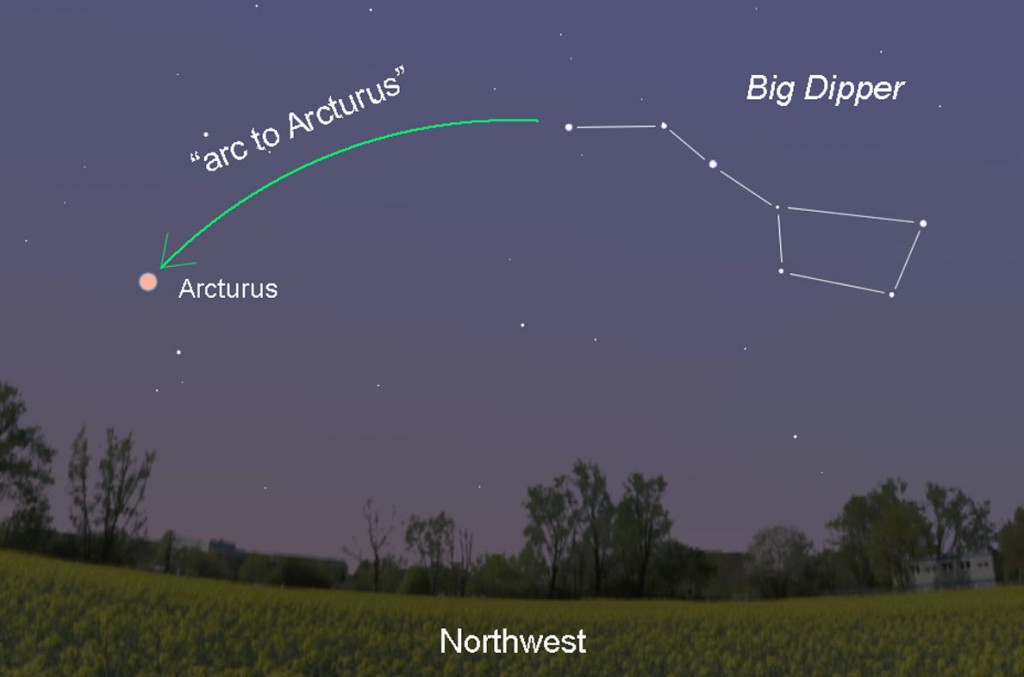
Do note that it won't be as far west as the picture (taken in mid-September) indicates.

This star is Arcturus, the second-brightest star in the night sky of the northern hemisphere, and the centerpiece of the constellation Boötes, the plowman. (Regrettably, the name isn't properly pronounced as "boots;" try "boh-OH-is," instead. However, I will forgive you for saying "boots," as I am guilty of doing it even though I know better.)

Anyway. Once you find Arcturus, begin moving your gaze eastward. The next bright star you find will be Vega (like the Street Fighter character), of the constellation Lyra. If you move your gaze to the southeast, you'll see a second bright star: Altair (like the Final Fantasy village) of the constellation Aquilla. Returning to Vega and looking toward the northeast, you will find a third bright star forming the "head" of a cross-shape formed by three dimmer stars. This bright star is Deneb, of the constellation Cygnus. (As far as I know, no video games reference Deneb.)

Vega, Deneb, and Altair form the corners of the Summer Triangle. Again, from Astrobob:
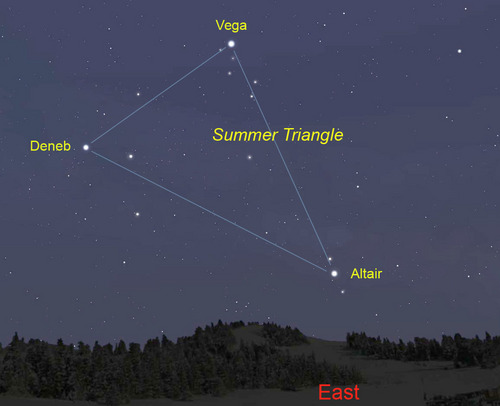

You should be able to see these three stars even if you live in an urban area with a lot of light pollution. This next step, however, requires you to look from a suburban or rural area, and be carrying a telescope or pair of binoculars.

As you probably know, our galaxy's shape is that of a flat disc. "Flatness," especially in this case, is a matter of proportion. Compared to its 575,205,347,300,000,000-mile (or so) diameter, the Milky Way's 76,694,046,300,000,000-mile (or so) thickness is quite flat.

Since we're looking out at the disc from an object inside the disc (and located toward its outer rim), we perceive the bulk of it a wide band arching across the firmament. In the absence of light pollution, it is dimly visible to the naked eye as a pale streak stretching from one horizon to the next. Not understanding the nature of what they were looking at, the ancients named it the Milky Way and invented a myth to explain it. When we came to realize that the arc represented the largest visible portion of our parent galaxy, we came to identify that galaxy by the name given to the visible arc.

(I apologize if I am repeating something you already know. But from what I recall from my thirteen years in the United States' public school system, I don't believe the curriculum ever addressed anything beyond Pluto in much detail. I can't be certain what anyone else reading this knows or doesn't know.)

The Summer Triangle is superimposed over the Milky Way band. If you're looking from a sufficiently dark region, you don't need me to point this out to you. It can be visible from the suburbs, but you'll need an optical aid. (More powerful is always better, but you can still get a decent glimpse using a pair binoculars designed for, say, watching a football game from the nosebleed section.)
All you have to do is point your scope or your nocks into the center of the triangle and look. If you've never tried it, you might find yourself shocked at how much stuff is out there -- how much light from how many stars are hitting your optic nerves all at once. In a place with moderate light pollution, you might see hundreds. In a place with little or no light pollution, you may see thousands.

If you attended public school in the United States (as I did), you probably received a crash course in astronomy. Chances are that curriculum botched it, as my school's did. The lesson probably went something like this:

"The Moon orbits the Earth. The Earth orbits the Sun. The Sun is very large and made of incandescent gas. The other stars are like the sun, but they are very far away. Are you writing this down? The true/false quiz is on Thursday."

We make a grave mistake by teaching students the facts without informing them as to how we arrived at them. This is like making them memorize the solutions to math problems without teaching them how the problems are solved.

Teaching the facts of science without teaching the methods is only marginally better than pointless.

The purpose of science is to arrive at a more accurate understanding of the physical world though repeated observation, testing, and logical reasoning, with methods that are available for anyone (with the proper know-how and materials) to duplicate themselves. When the answers are given without reference to the process, the student cannot properly appreciate them. For all he knows, the facts in his textbook came from some Neo-Delphic Oracle sealed in a wine casket in some Princeton basement.

On a political note: if science wants to assert itself as the superior alternative to religious dogma where finding out the physical facts is concerned, scientific education must make a better effort toward demonstrating to students that it can do one crucial thing that dogma cannot -- it can show its work.

For instance:

We know that the moon orbits the Earth because of how is path across the celestial sphere differs from those of the sun, the planets, and the stars. We know the Earth orbits the sun for the same reason, and by the same logic we find that the other planets orbit the sun as well. (Mr. Copernicus outlines it very succinctly and eloquently, even though he does fudge a few relatively minor details.)

We deduce that the sun is very large because, for starters, we can use radar to acquire a precise measurement of Venus's distance from Earth in kilometers, and then use that number in conjunction with Kepler's Third Law (p^2 = a^3) to find the a value of a (in this case, 1 A.U., or one "Earth-distance") in kilometers. Knowing exactly how far away Venus is from Earth, and knowing exactly how far away the Sun is from Earth, we observe that the sun appears thirty times larger than Venus in the sky, despite being 2.6 times farther away. The conclusion draws itself.

We understand that the stars are very far away because of observations involving stellar parallax. (Hold your raised index finger six inches from your eyes. Close your left eye. Now open it and close your right eye. Notice how drastically the apparent position of your finger seems to change in relation to object behind it. This is parallax. When we view objects like the Moon or planets from different positions on the Earth's surface,and compare where they appear to lie relative to the stars, we observe a similar displacement.

We know that the stars are similar to the sun in composition because spectroscopic analysis turns up evidence of the same basic materials in the sun and in pretty much every other star we can find.

(I should mention that I am by no means whatsoever an expert or authority. I am only an amateur who wants to share what he has learned.)

Before you take a good look, it helps to know what you're seeing, especially in this case. An object like a star is impossible to touch, approach, turn over, smell, etc. When we tell a student that the star he sees is one particular thing as opposed to numberless other particular things, it is no less important that he gets some understanding of how we came to this conclusion. Otherwise, he has as much a basis for believing that the twinkling dots he sees in the night sky are tremendous fusion-fueled orbs billions of miles away as he does for believing that the weatherman is telling the truth when he smiles, winks, and pulls up the Santa Radar on Christmas Eve. (Do weathermen still do this?)

So what are we seeing when we aim our scope into the middle of the Summer Triangle? The short answer is "stars." Thousands upon thousands of the billions upon billions of stars composing the Milky Way galaxy. Most of these stars are at least similar in size to our Sun, whose diameter is somewhere in the vicinity of 64,950 miles. (Our entire world's diameter amounts to 7,926 miles, remember.) Though they appear close together, the distances between each of these points of light you see are so tremendous that to reckon them in miles would make about as much sense as measuring the length between city blocks in millimeters.

What you're looking at is Eternity. But only a sliver of it.

Thanks to advancements in optics, we now understand that the Milky Way is just one galaxy out of billions and billions.

Here's a fun experiment! This BBC article might be outdated and/or inaccurate, but that's okay. It gives us a number to play around with: 156 billion. Let's say that the universe is 156-billion light-years wide. If we're assuming it's a sphere (the truth is probably a lot more complicated and far beyond my ability to approach), that gives it a radius of 78 billion light years -- or 458,200,000,000,000,000,000,000 miles. Now if we calculate the volume of a sphere with a radius of 458,200,000,000,000,000,000,000, we get...

(4/3) * (π) * (458,200,000,000,000,000,000,000)^3 = oh jeez.

Uh...I'm getting 40,295,250,862,323,019,768,114,206,530,184,000,000,000,000,000,000,000,000,000,000,000,000,000 cubic miles. This is a very sloppy, simplistic, and definitely incorrect approach (it doesn't account for any relativistic space-stretching voodoo, for one thing), but it gives us some idea of how far existence might go. (Earth's volume is about 259,875,899,200 cubic miles. Subtract that from the "number" up above and contemplate how much stuff that's not us is.)

It is very easy not to think about this in your daily life. Most of us probably don't give it a second thought. Stargazing is a pursuit that rather forces you to confront this reality -- though usually in small doses. (When faced with a number as large as the one above, the size of the Milky Way is no less piddlingly infinitesimal than that of the Earth.)

I don't know of anyone who has not been taught that the Earth revolves around a massive Sun and that the universe outside our neighborhood is bigger than we can possibly imagine. Most of us are even used to the idea, but the fact is so rarely brought to bear on our day-to-day existence that we rarely appreciate the significance of this fact.

You can look at Hubble images and listen to Carl Sagan wax poetic about the cosmos, but neither brings you into direct contact with the subject. This is why you need to sometimes go out and be touched by it -- to see, with your own eyes, a thousand stars stretched out over billions of miles.

When formulating an opinion or viewpoint on any subject, it is important to consider as much of the whole of the situation as possible. Otherwise you risk an incomplete conclusion.

When we evaluate ourselves, our world, and ourselves in the context of our world, we cannot omit the underlying facts of the situation. Though we rarely have any direct contact with it, Eternity is there. When assessing himself and his environment, the average person fails to factor it into his personal equation.

Why should he, though? Why fuss over something that brings no immediate (or even perceptible) weight upon his health, his friends, his career, and his hobbies?

This has already careened far enough along for now, but for now I'll close with a question. Even if a person has not given it any direct thought, he is very likely to have already arrived at his answer without being asked.

"Which is more real: the part(s) of reality existing closest to me, or the parts of reality occupying the greatest percentage of the whole?" 

[cont.]

Edit: Says a commentator on Twitter:

they're both equally real this question is dum

I was afraid of this. Maybe that's not the question I want to ask. Maybe what I'm turning over in my addled brain is a matter of significance.

Are the constituents of reality which exist in closest proximity to my experience more significant than the overwhelmingly larger span of reality (matter, energy, time, space, et al) existing outside of my environs?

Why or why not?

And why should this question strike most as an "empty academic point?"

Tuesday, July 5, 2011

Blah blah blah

This weekend I bit the bullet and spent a very, very long time revising some of my old articles about a certain Japanese video game series. It was an unbelievable pain in the ass, but it's DONE. I didn't even really want to do it, but -- well, OCD is a pretty powerful motivator. The things have my name on them and they were pretty insubstantial compared to the later additions, so I fleshed them out a bit to bring them up to par. This would also be why I don't have a post prepared for this week.

God, I need something else to think about. Something to flush the Espers and dragons out of my brains.

On the agenda for the next few weeks:


  • Give The Zeroes (my unpublished n-v-l; only when it gets published in some form or other will I be comfortable with calling it my novel) one last editorial sweep and get ready to e-bookerize it. I might also look into a pay-per-print service, but we'll have to wait and see about that.

  • Comics! I'm doing a little "miniseries" about a famous roller from Greek myth. One page is complete. Six more will follow. Also, I've been seriously considering setting up a new website for my drawn comics, so I can keep them and the old pixel comics in a separate place. It's about time I find a new host, anyhow...

  • Oh, and there's still that OTHER thing -- n-v-l number two. I've been taking a two-week breather from it, but it's starting to really gnaw at me again. Guess I'll just have to let it. For the time being, making n-v-l number one available to the public and making cute little comics to attract the immediate attention of that public takes priority.


    No rest for the broke and driven. Maybe something good will come of it all.

    My friend Jeff got married two weeks ago. I was the best man, so I had to give a toast. The geek that I am, I thought it would be appropriate to offer the happy couple my blessing by raising a glass to Shakespeare's 116th sonnet (which I imagine gets a whole lot of play in the wedding circuit). For your reading pleasure:

    SONNET 116

    Let me not to the marriage of true minds
    Admit impediments. Love is not love
    Which alters when it alteration finds,
    Or bends with the remover to remove:
    O no! it is an ever-fixed mark
    That looks on tempests and is never shaken;
    It is the star to every wandering bark,
    Whose worth's unknown, although his height be taken.
    Love's not Time's fool, though rosy lips and cheeks
    Within his bending sickle's compass come:
    Love alters not with his brief hours and weeks,
    But bears it out even to the edge of doom.
    If this be error and upon me proved,
    I never writ, nor no man ever loved.


    Note #1: My recitation omitted the "O no!" in line five. I couldn't find a way of working it in without killing the rhythm.

    Note #2: "Bark" is an old term for "ship." You know -- ships were made of wood, wood comes from trees, trees are covered in bark...

    Note #3: When Shakespeare wrote this poem, "proved" rhymed with "loved" and "come" rhymed with "doom." This certainly isn't the only time the evolution of English pronunciation has worked against the bard. I always get blue balls from the very first lines of Macbeth:

    When shall we three meet again
    In thunder, lightning, or in rain?
    When the hurlyburly's done,
    When the battle's lost and won.
    That will be ere the set of sun.
    Where the place?
    Upon the heath.
    There to meet with Macbeth.

    HEATH IS SUPPOSED TO RHYME WITH MACBETH BUT IT DOESN'T ANYMORE. MOTHERFUCKER.

  • Monday, June 27, 2011

    Damselflies!


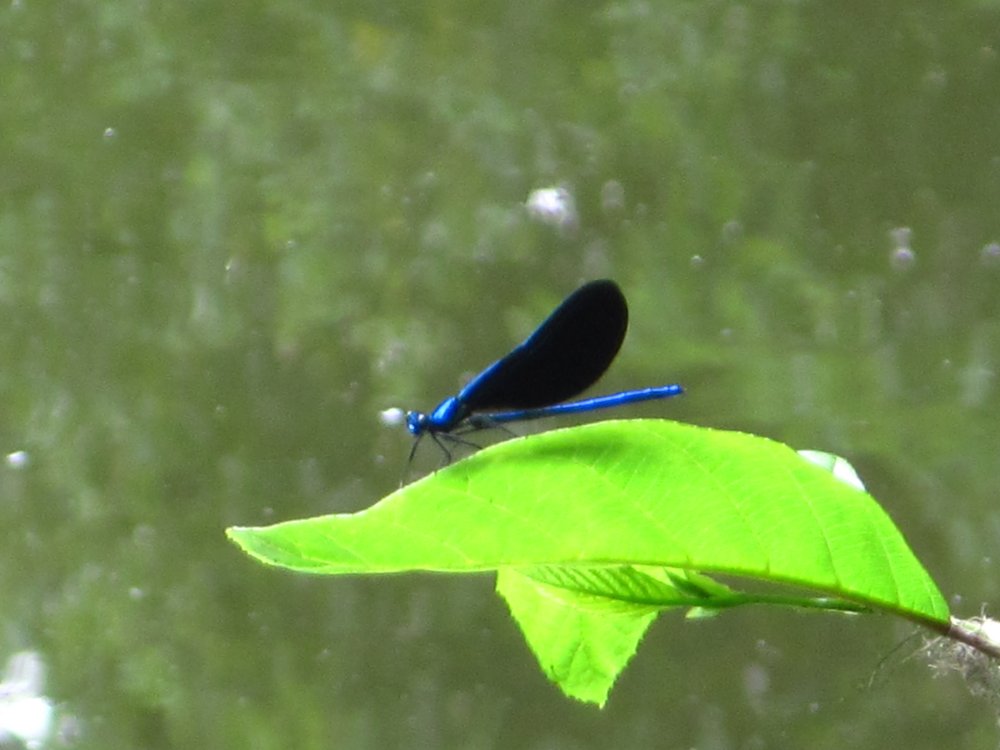
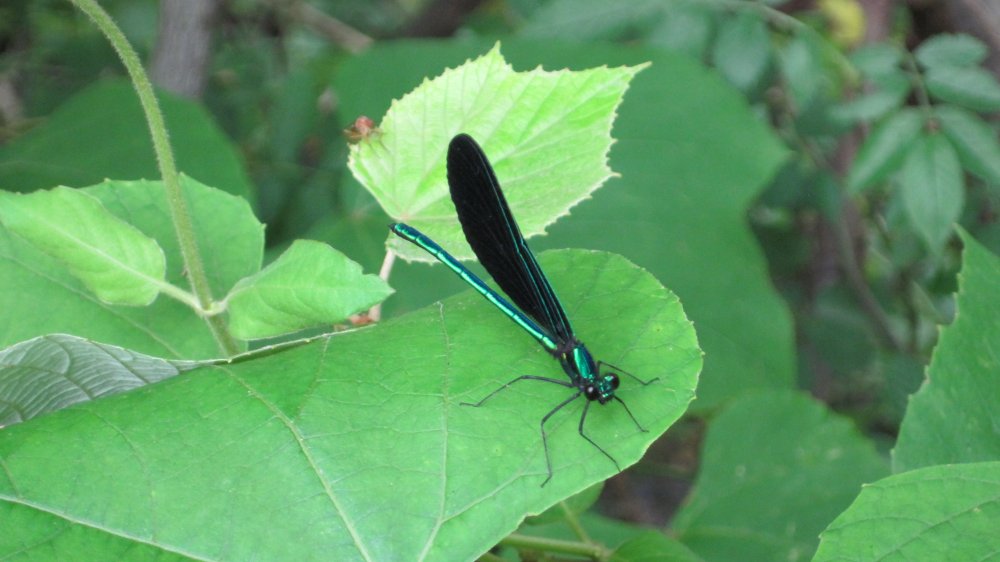
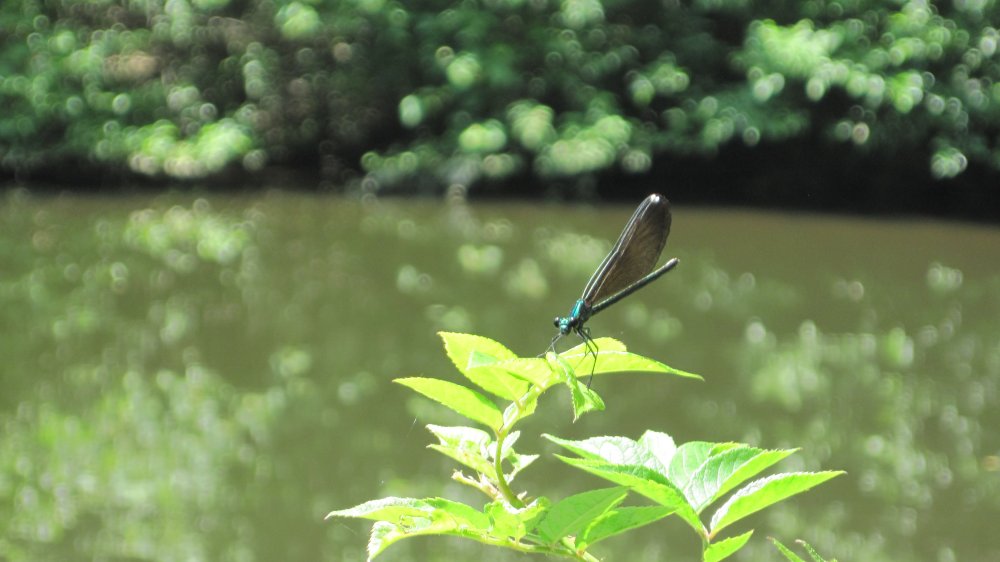
    During that silly freewrite post last week (empty-handed desperation will lead to some strange choices), I mentioned damselflies and posted a picture of one. Let's take a closer look at these little buggers, because they're kinda one of my favorite things about living on this planet.


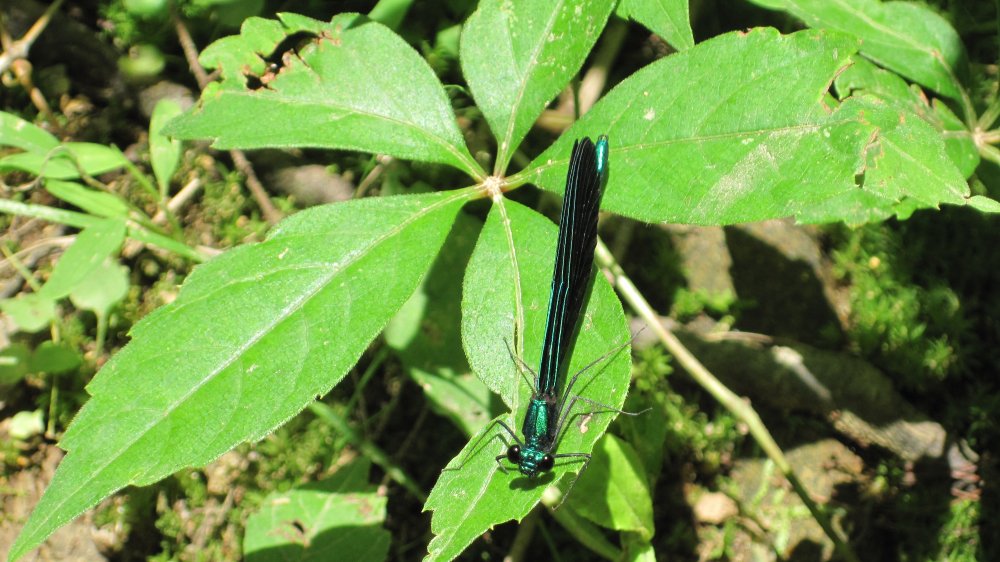
    The one species of damselfly that seems to live around here is Calopteryx maculata -- the ebony jewelwing. Every so often I'll see one or two elsewhere, but there's a pond a few miles down the road where dozens gather on summer afternoons. I keep trying to convince people to take the trip with me, but for some reason they always seem reluctant to sit down in the woods and stare at bugs with me for an hour. Clearly there is something wrong with everyone else in the world.


    Look at him. He's almost as cute as a horseshoe crab, and nearly as ancient. Fossils belonging to an extinct subgroup of the order Odanta (which the damselfly shares with its more well-known and vigorous cousin, the dragonfly) have been dated 325,000,000 years old, while the oldest fossils belonging to recognizable members of the Zygoptera suborder (i.e., damselflies) date back 250,000,000 years. Although not quite as Darwin-vintage as our friends in the Limulidae family, Damselflies apparently haven't changed that much in the last couple hundred million years. Their bodies still have weird, outmoded ways of doing things -- mating, for one. You can look it up for yourself, but I will just mention here that it involves the male grabbing the female by the neck with his anus.

    Of course, I'm not a biologist or a bug authority of any kind -- in fact, I just now had to look up those numbers and Latin names on this handy web page. Rather than paraphrasing and thereby diluting the information any further, let's quote right from the fountainhead:

    Many characteristics distinguish Odonata from other groups of insects -- minute antennae, extremely large eyes (filling most of the head), two pairs of transparent membranous wings with many small veins, a long slender abdomen, an aquatic larval stage (nymph) with posterior tracheal gills, and a prehensile labium (extendible jaws underneath the head). Among living Odonata, there are twenty-five families, mostly dragonflies and damselflies. Of all their characteristics, the easiest way to tell a dragonfly or damselfly from other insects is by the size of the eyes and shape of the abdomen. If the eyes are very large in proportion to the head and the abdomen is long and thin, then it is almost sure to be in Odonata.

    While both dragonflies and damselflies belong to the Odonata and share many common features, then are a number of noticeable differences as well. Even before hatching from the egg, differences in morphology of the egg distinguish dragonflies (Anisoptera) from damselflies (Zygoptera). Dragonfly eggs are round and about 0.5 mm long, whereas damselfly eggs are cylindrical and longer, about 1 mm long. Similarly, the nymphs (larvae) of the two groups differ. A larval damselfly abdomen is longer and narrower with three fin-like gills projecting from the end. Dragonfly nymphs are shorter and bulkier, and the gills are located inside the abdomen. The dragonfly nymph expands and contracts its abdomen to move water over its gills, and can squeeze the water out rapidly for a short burst of underwater jet propulsion.....

    Both major suborders have large heads with very large compound eyes relative to the rest of their body. Each compound eye is composed of nearly 28,000 individual units (ommatidia), and together the eyes cover most of the head. More than 80% of their brain is devoted to analyzing visual information. By contrast, their antennae are tiny. Their mouths have been adapted for biting, making them efficient hunters. All Odonata have a prehensile labium, which can be extended forward from underneath the head faster than most prey can react, making their bite fatal to prey. The six legs are all located near the head and are seldom used for walking, but are more useful in catching prey and perching on vegetation to rest or lay eggs.

    Both dragonflies and damselflies have two pairs of elongated membranous wings with a strong crossvein and many small veins that criss-cross in the wings, adding strength and flexibility to the wings. Both groups also have a characteristic nodus, or notch, in the front edge of each wing. In dragonflies, the rear wings have a broader base and are larger than the front pair. Damselflies, by contrast, have front and hind wings similar in shape, and as a result they fly slower than dragonflies do. Also, dragonflies do not have hinges enabling them to fold their wings together when resting, though damselflies do. This feature of the wings is the key morphological feature distinguishing adult dragonflies from damselflies.

    Finding damselflies isn't that tough. Just go to a large wooded area and look for water. It is very important that there be sunlight; damselflies tend to stay put during cloudy weather. What you're keeping an eye open for is a bug that looks like a dragonfly but moves like a butterfly.
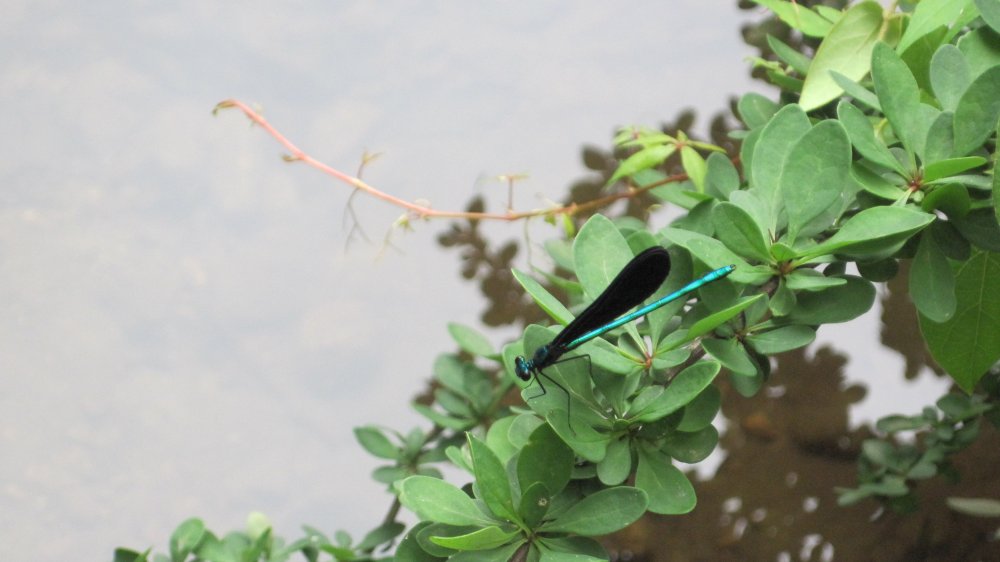
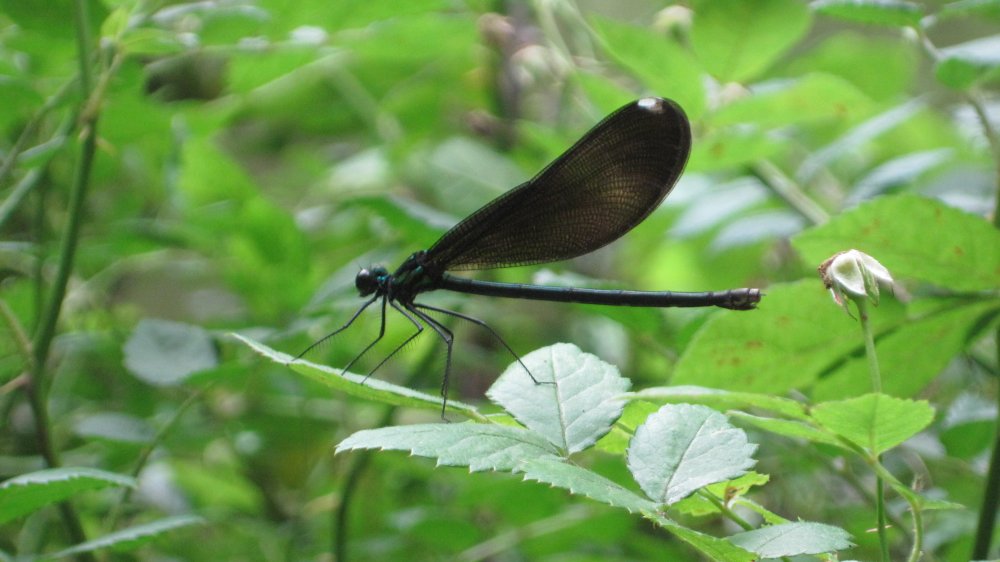
    Taking pictures of these things isn't easy, unless you have a camera capable of extreme zooming (which I do not). Damselflies are shy. They'll just sit on a leaf and stare at you until you come within about six feet of them. At that point they'll jump and flit about until they're out of reach, land, and resume their staring. (And what cute little cold black eyes they have!) Taking these photos took a few minutes; most of the time the bugs didn't allow me to get close enough to snap a sufficiently detailed photo, but I got lucky every now and then.


    They can move fast when they want to, though. If you watch them long enough, you might see a pair of males sparring. They'll approach each other in flight, stop right in front of each other, and hover in place for a few minutes. Their wingflaps become harder and more rapid, and then they'll start darting about like their dragonfly cousins, chasing and ramming into each other. I'm not really sure what's going on when this happens: I've been unable to discern if they're actually biting or inflicting any serious bodily damage on each other. I'm also not sure what the rules on stopping are: sometimes one will tap out and land somewhere, and the other will just flutter off in another direction. Once last year I watched a fight between a pair of males that must have lasted about ten minutes: every time the one removed himself from the fight and landed to take a breather, the other would immediately swoop back down on him and chase him around again. ("Well, animals are a lot like people, Mrs. Simpson....Some of them are just jerks.")


    Distinguishing a male from a female is simple, at least as far as ebony jewelwings are concerned. The females are generally a dull, somewhat iridescent blackish-gray color that sometimes contains tints of other colors (I see a lot of purple and green). Their wings will be more transparent than the males', and will have white dots on the high tips.


    Though the female has its charm, the male damselfly is comparatively brilliant. Most I've seen are either an emerald green or a deep cerulean, but I suspect that the difference hasn't to do with the individual bug, but on the lighting. I'm fairly positive I've seen a blue damselfly flap into the shade and become green by the time he landed. (I'll post something new if/when I verify this.)


    And they're even cuter during their youth, when they squirm underwater as vicious, cannibalistic nymphs!


    (I should mention that I did not record this. I've never been able to find any of these things, much less catch them.)

    Again, from the University of California Museum of Paleontology:

    Most of a dragonfly's life is spent in the larval stage where it molts from six to fifteen times. Depending on altitude and latitude, larval development varies from the common one or two years to as many as six years. At that time, the nymph crawls up out of the water and molts one last time, emerging from its old skin as an adult with functional wings. Unlike butterflies and beetles, dragonflies and damselflies do not have an intermediate pupal stage before becoming an adult. Because of this, Odonata are said to be hemimetabolous, or undergo an "incomplete" or "gradual" metamorphosis.

    Dragonflies and damselflies begin their lives as nymphs, living underwater for a year of more....The nymphs are not as brightly colored as the adults, but are well camouflaged predators who ambush their prey.

    And I haven't got much else. Those first two pictures at the top are from a year or two ago; today I went out to collect some more (for your viewing pleasure). You can click on any of them for a higher-resolution version.

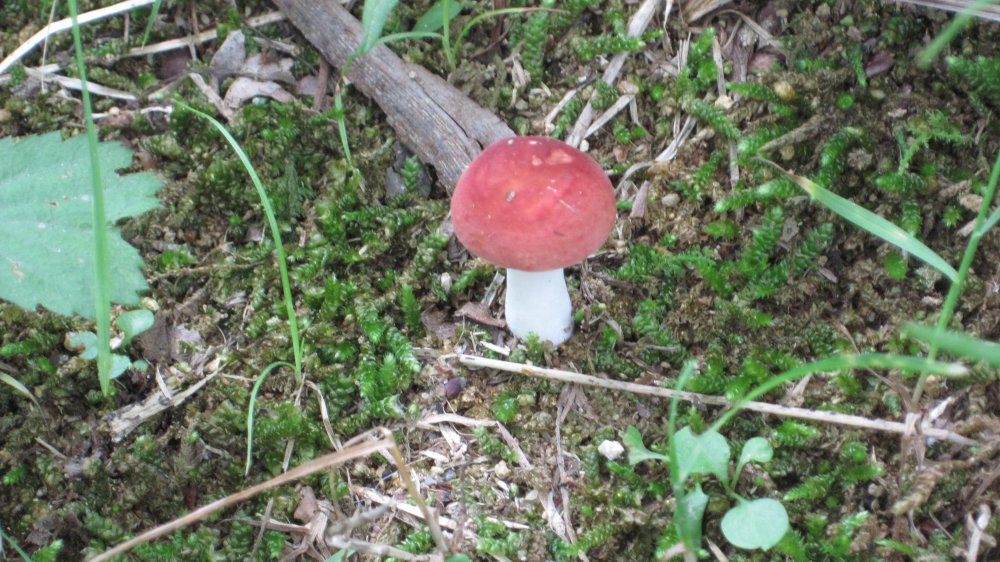
    On the way to the pond I met a dapper little mushroom:


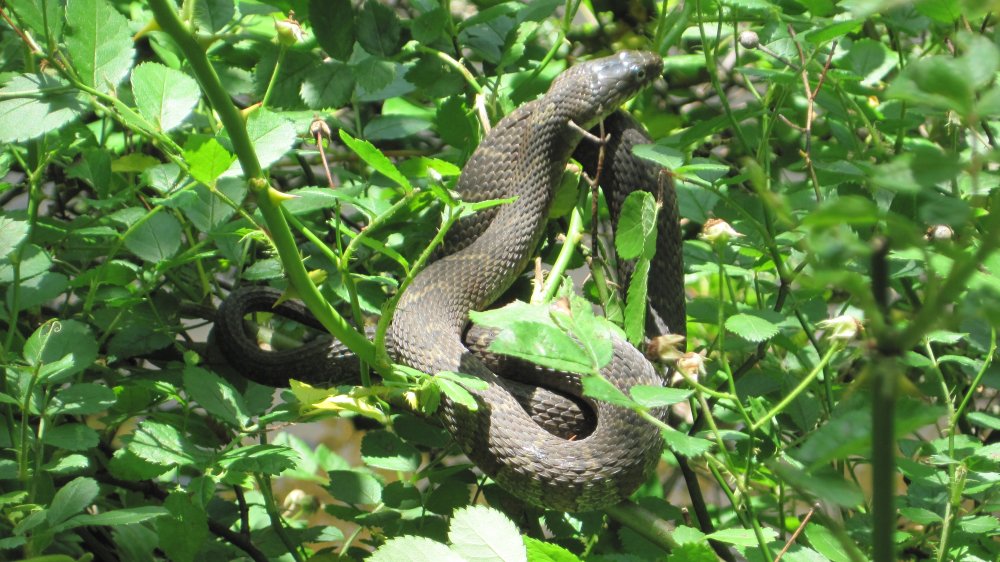
    And when I arrived, I found this gentleman sunning himself in a bush:


    There was also a huge turtle floating in the middle of the pond, but he went under before I could get a snapshot of him.

    I enjoy my hobbies, but they're probably one of the reasons I have such a hard time getting dates.

    Monday, June 20, 2011

    Art of the Freewrite

    And once again, I've had too much other stuff going on this week to produce any interesting new content. Think of this post as a small down payment toward more substantive updates in the future. (Also: drawing is difficult and time consuming.)

    Earlier today I was looking through an old notebook and found a freewrite I remember doing about a year ago. It's really not long or good enough to be the the centerpiece of my weekly obligation to the Web Log Sphere, but...hm. Let's turn this into a participatory event.

    Though I don't often do much freewriting, it can be an eminently invaluable exercise. Its main function is as a laxative for the part of the brain that tells the hand what letters to write. When you find yourself struggling to put an idea into words or laboring to produce an idea worth putting into words, one of the best methods of unclogging the works is to stop thinking about what you're writing and just write. Sit down, look at what's around you, and jot down your thoughts as they come. They probably won't be brilliant. You almost definitely will not end up with something worth mailing to The New Yorker. But you will often surprise yourself, and you can sometimes produce something to which you can hold on for future use. (Personally, I disagree with the Beats' "first thought, best thought" credo. The first thought provides the raw material for subsequent thoughts to chisel into form.)

    Below this I've typed up the product of that freewriting session from last year. These are my unprocessed, undeliberated, and possibly addlebrained thoughts from a five-minute period last summer. By reading this text here you are agreeing to to click the "comments" link below and post a freewrite of your own within the next two days. Sit down somewhere for five minutes, take in your surroundings, and write without thinking, then post what you came up with. Should you choose to read on without posting a freewrite of your own, you will be breaking the obligation to which your reading and understanding this sentence has binded you, and that would be kind of a dick thing to do.

    And now, here's some stuff I jotted down in a notebook last year without really thinking it over:


    Dull drab Sunday afternoon. By the pond. Damselflies fan their wings and scuttle through the air in lazy amours. Dragonflies pursue dragonflies over the water in pointed, angled paths.

    Ripples: fish from below or discrete drops from above, distorting the apparitions of birch leaves on the surface.

    I toss a stone.

    Ripples meeting ripples, ripples changing ripples. New thoughts impelling old ideas on new trajectories, old thoughts putting new ideas to harder scrutiny, redirecting each current even as its position becomes clearer.

    Too much to ask for stillness. The birches stirring in the wind above, undulating in the pond below.

    The dragonflies haven't tired of chasing each other yet.

    A damselfly lands on my bare big toe.

    Not Thoreau's sparrow, but a compliment is a compliment.


    If you've read this far, you owe me five minutes of your own transcribed thoughts. Get cracking.

    Monday, June 13, 2011

    Status Update

    Oh man. Is it really Monday again? And do I really have nothing prepped for our weekly heart-to-heart? Guess I'll have to do some improvisational diary writing in order to meet the quota. My apologies, then: today I will be writing about myself rather than anything interesting.

    Well, what's to talk about?

    I need a paying job that doesn't bore the hell out of me. Stargazing has been difficult lately: if we're not getting absolutely crummy visibility from overcast skies, we're getting infinitesimally less absolutely crummy visibility from the humidity and haze. (Peter Segal: "In the era of new austerity, the government has decided to eliminate spring. We can have three seaons: hot as hell, cold as hell, and baseball postseason.") My attempts at self-teaching myself the methods of unlocking the heavens' secrets through the astronomy textbook I bought on discount just before quitting my job at the bookstore proceed steadily but slowly: science ain't easy, especially for someone who consistently got C's and D's in every math course up from pre-algebra.

    Oh, and there's my writing.

    Yes. There's that.

    My plan for the first n-v-l (which has been finished for about a year and a half now) is to publish it as an e-book, just so the damn thing is finally out of my hands. But before moving forward, I'm going to have to subject it to one final editorial pass. After not having even glanced at it since December, I hope that any typos, poor diction, redundancies, and, well, lousy writing, will be more evident to me than they were six months ago.

    Of course, once it becomes an e-book, I'm gonna have to promote it, which will be an exceedingly miserable and exceedingly crucial labor. (This would be my primary reason for wanting to get a publisher: it would mean not having to put aside writing for three months in order to spend all my time finding creatively intrusive ways of flaunting something already written.) This will likely necessitate taking up a regularly-updated and very, very accessible ancillary project, like a new webcomic or series of classic video game reviews. I can't say I've been feeling particularly inspired on either front lately, but a fish probably ain't gonna bite a hook without any bait.

    (The traditional publisher route may not be a totally lost cause yet. I recently discovered that a friend of mine from high school started an "indie" press in Seattle. I realize that my familiarity with the man in charge shouldn't give me that much greater a chance of seeing the n-v-l in print, but it's difficult for one not to get his hopes up until he receives a definite "no.")

    Around last August I began another project. Like the first n-v-l, it was intended as a novella, but before long I realized it wanted to be another full-lengther.

    It originally began as "hey, I've never written a love story. That would be a fun challenge, huh?"

    I don't know why I can't stick to what's easy. It would probably be much better for my mental well-being, not to mention my lungs.

    Writing this thing has been like trying to break through a concrete wall. After hitting a tremendous snag around January -- during which I would write a chapter one week, throw it out the next, write a chapter, throw it out, week after week -- sometime in March I realized a way out. It was so obvious! I knew how I could make it work, and all I had to do was completely change the main character and rewrite 80% of what I had. I don't think I've ever feel such intense extremes of joy and exasperation at precisely the same moment.

    So now I'm rewriting it with a much greater sense of focus -- at least where the meaning of the piece is concerned. But that hasn't made it any easier. Actually, now that I have a clearer fix on the concept, I have to work that much harder to make sure all the lines incline in its direction. And the further I try to follow it where it seems to want to go -- where the lines appear to lead -- the more difficult it gets to keep up with it.

    I've rewritten or retooled the first four chapters. The fifth is completely unable in its current form. In addition to totally rewriting its first half, I'm adding a transitional chapter between it and the fourth, which has been a trip and a half.

    I like the aim. I'm really enjoying what I'm trying to do, but the actual effort toward achieving it has been an absolute bitch -- and I can't even be sure of how the results are turning out. While you're in the thick of it, it's hard to tell.

    Trying to take a piece into strange and difficult territory presents a twofold problem:

    1.) It's not easy to write. Not as easy as it is when you're playing it safe and doing what you (and your prospective audience) already know.

    2.) Even fewer people are likely to read it. The novel is an medium for which the modern Internet-calibrated consumer attention span has precious little patience. Judging by the number of people praising novels for being "easy" and "quick" reads, we can assume today's reader doesn't appreciate a challenge.

    It would make so much sense to just walk away from it. But I can't. It's the last thing I think about when I'm falling asleep, and the first that enters my mind when I wake up. I need to break down this fucking wall. Even if the final result doesn't measure up to the idea, even if it ends up not doing what I hoped it would, even if nobody reads read, at least it'll be done -- out of my head and out of my hands.

    I guess that's the one benefit to being a broke, unread, in-it-for-the-love artist: I can take as long as I need on project, and have the total freedom to write the sort of thing I think should be written. (However, inexperience prevents me from saying whether this is better than actually getting paid to do what you're good at, even though it might entail compromise and bottomline-think.)

    I think that should suffice for now. I owe somebody a few comics strips about a certain damned figure from Greek myth, so look out for those in the near (I hope) future.

    Tuesday, June 7, 2011

    The Polis


    Man. Why didn't I start reading the Greek philosophers sooner? An excerpt from Aristotle's Politics, read and stolen from this page. I don't pretend to know the translator.


    Every State is a community of some kind, and every community is established with a view to some good; for mankind always act in order to obtain that which they think good. But, if all communities aim at some good, the state or political community, which is the highest of all, and which embraces all the rest, aims at good in a greater degree than any other, and at the highest good.

    Some people think that the qualifications of a statesman, king, householder, and master are the same, and that they differ, not in kind, but only in the number of their subjects. For example, the ruler over a few is called a master; over more, the manager of a household; over a still larger number, a statesman or king, as if there were no difference between a great household and a small state. The distinction which is made between the king and the statesman is as follows: When the government is personal, the ruler is a king; when, according to the rules of the political science, the citizens rule and are ruled in turn, then he is called a statesman.

    But all this is a mistake; for governments differ in kind, as will be evident to any one who considers the matter according to the method which has hitherto guided us. As in other departments of science, so in politics, the compound should always be resolved into the simple elements or least parts of the whole. We must therefore look at the elements of which the state is composed, in order that we may see in what the different kinds of rule differ from one another, and whether any scientific result can be attained about each one of them.

    He who thus considers things in their first growth and origin, whether a state or anything else, will obtain the clearest view of them. In the first place there must be a union of those who cannot exist without each other; namely, of male and female, that the race may continue (and this is a union which is formed, not of deliberate purpose, but because, in common with other animals and with plants, mankind have a natural desire to leave behind them an image of themselves), and of natural ruler and subject, that both may be preserved. For that which can foresee by the exercise of mind is by nature intended to be lord and master, and that which can with its body give effect to such foresight is a subject, and by nature a slave; hence master and slave have the same interest. Now nature has distinguished between the female and the slave. For she is not niggardly, like the smith who fashions the Delphian knife for many uses; she makes each thing for a single use, and every instrument is best made when intended for one and not for many uses. But among barbarians no distinction is made between women and slaves, because there is no natural ruler among them: they are a community of slaves, male and female. Wherefore the poets say,

    "It is meet that Hellenes should rule over barbarians;"

    as if they thought that the barbarian and the slave were by nature one.

    Out of these two relationships between man and woman, master and slave, the first thing to arise is the family, and Hesiod is right when he says,

    "First house and wife and an ox for the plough,"

    for the ox is the poor man's slave. The family is the association established by nature for the supply of men's everyday wants, and the members of it are called by Charondas 'companions of the cupboard,' and by Epimenides the Cretan, 'companions of the manger.' But when several families are united, and the association aims at something more than the supply of daily needs, the first society to be formed is the village. And the most natural form of the village appears to be that of a colony from the family, composed of the children and grandchildren, who are said to be suckled 'with the same milk.' And this is the reason why Hellenic states were originally governed by kings; because the Hellenes were under royal rule before they came together, as the barbarians still are. Every family is ruled by the eldest, and therefore in the colonies of the family the kingly form of government prevailed because they were of the same blood. As Homer says:

    "Each one gives law to his children and to his wives."

    For they lived dispersedly, as was the manner in ancient times. Wherefore men say that the Gods have a king, because they themselves either are or were in ancient times under the rule of a king. For they imagine, not only the forms of the Gods, but their ways of life to be like their own.

    When several villages are united in a single complete community, large enough to be nearly or quite self-sufficing, the state comes into existence, originating in the bare needs of life, and continuing in existence for the sake of a good life. And therefore, if the earlier forms of society are natural, so is the state, for it is the end of them, and the nature of a thing is its end. For what each thing is when fully developed, we call its nature, whether we are speaking of a man, a horse, or a family. Besides, the final cause and end of a thing is the best, and to be self-sufficing is the end and the best.

    Hence it is evident that the state is a creation of nature, and that man is by nature a political animal. And he who by nature and not by mere accident is without a state, is either a bad man or above humanity; he is like the

    "Tribeless, lawless, hearthless one,"

    whom Homer denounces -- the natural outcast is forthwith a lover of war; he may be compared to an isolated piece at draughts.

    Now, that man is more of a political animal than bees or any other gregarious animals is evident. Nature, as we often say, makes nothing in vain, and man is the only animal whom she has endowed with the gift of speech. And whereas mere voice is but an indication of pleasure or pain, and is therefore found in other animals (for their nature attains to the perception of pleasure and pain and the intimation of them to one another, and no further), the power of speech is intended to set forth the expedient and inexpedient, and therefore likewise the just and the unjust. And it is a characteristic of man that he alone has any sense of good and evil, of just and unjust, and the like, and the association of living beings who have this sense makes a family and a state.

    Further, the state is by nature clearly prior to the family and to the individual, since the whole is of necessity prior to the part; for example, if the whole body be destroyed, there will be no foot or hand, except in an equivocal sense, as we might speak of a stone hand; for when destroyed the hand will be no better than that. But things are defined by their working and power; and we ought not to say that they are the same when they no longer have their proper quality, but only that they have the same name. The proof that the state is a creation of nature and prior to the individual is that the individual, when isolated, is not self-sufficing; and therefore he is like a part in relation to the whole. But he who is unable to live in society, or who has no need because he is sufficient for himself, must be either a beast or a god: he is no part of a state. A social instinct is implanted in all men by nature, and yet he who first founded the state was the greatest of benefactors. For man, when perfected, is the best of animals, but, when separated from law and justice, he is the worst of all; since armed injustice is the more dangerous, and he is equipped at birth with arms, meant to be used by intelligence and virtue, which he may use for the worst ends. Wherefore, if he have not virtue, he is the most unholy and the most savage of animals, and the most full of lust and gluttony. But justice is the bond of men in states, for the administration of justice, which is the determination of what is just, is the principle of order in political society. . . .

    Sunday, June 5, 2011

    Crab Census

    Don't have much of anything prepared for this week, I'm afraid: for the last four days or so I've been kept out of town and away from my writing desk by various obligations, not the least of which was the annual Delaware Bay horseshoe crab census at the extreme southern end of New Jersey (far south enough that the locals can be heard saying "y'all" and "youse"). My friends and I volunteered last year and had so much fun that we decided to help out with the 2011 effort.

    The program and procedure are both pretty simple. From the mid 1800s through the 1960s, horseshoe crabs were harvested en masse from the Delaware Bay area to be ground up and sold as fertilizer. Between this, the increased human presence on the bay shores, and increasing demand for the crabs as eel bait and biomedical test subjects, the horseshoe crab population has seen dramatic decreases throughout and beyond the latter half of the 20th century. Delaware, Maryland, New Hampshire, New Jersey, and Virginia have imposed stricter regulations on horseshoe crab harvesting, while South Carolina (oddly enough) has imposed a permanent moratorium on the commercial fishing of horseshoe crabs for all industries except medical research.

    Beginning in 1990, the University of Delaware Sea Grant College Program and the National Oceanic and Atmospheric Administration have led and sponsored an annual series of crab counts at different sites through the Delaware Bay area during May and June (the peak of the species' mating season).

    The census is a straightforward affair: a group of about four to eight people (usually students, biologists, and local eccentrics) don their galoshes and hit the bayside beaches of Delaware and south Jersey at high tide during the days of, before, and after the new and full moons. They walk along the waterline with a pair of 1 x 1m PVC pipe squares (or "quadrants," if we want to sound more like the rigorous empirical investigators we are), laying them down at twenty-meter intervals and counting the number of horseshoe crabs inside each quadrant. (My job was carrying the clipboard, running back and forth between the two groups, and jotting down their findings.)

    And this brings us to the second, and probably more immediate question: horseshoe crabs? Why should anyone care?!

    The boxed buzzphrase most frequently used whenever someone finds himself compelled to write about horseshoe crabs is "living fossil." The term verges on cliché, but is none the less appropriate for it. Fossils belonging to members of the horseshoe crab family (Limulidae) have been found dating back to 430,000,000 BCE, and the animal hasn't changed much since then. (It should be mentioned, however, that the species in the Delaware Bay -- Limulus polyphemus -- seems to be a much more recent variation of the genus Limulus, which dates back "only" 20,000,000 years or so.) Horseshoe crabs shared the Pangean seabeds with the trilobites, scuttled in the passing shadows of plesiosaurs, survived two ice ages, and greeted Homo sapiens when he first emerged from the African jungles some 195,000 years ago. (Just to put our families' timelines in perspective: the earliest known Hominidae fossil has been dated a paltry seven million years old. I'll allow you to cross-multiply 430,000,000 and 7,000,000 and come up with a ratio on your own.)

    That the horseshoe crab evolved and proliferated under vastly different circumstances than most animals we see in our everyday experiences is obvious on a glance. The terrestrial life machine simply doesn't build them like this anymore. The horseshoe crab is the organic echo of an Earth that no longer exists; a classic model that keeps chugging along with the sleeker, more modern makes.

    Here's what it looks like from above.


    And now, underneath:


    Say what you will. I think it's cute.

    Note: none of the photographs in this entry belong to me or anyone in the census group. We all forgot to bring our cameras.

    Quick observational facts: the pair of larger pincers in the front -- one is partially cropped at the image's bottom -- tell us that this one is a male (it uses these to latch onto the female during mating). That fuzzy orifice toward the center is its mouth. Yes, those white things toward the front are barnacles; you'll also sometimes find mussels and other stationary sea critters hitching rides on horseshoe crabs' shells.

    While talking with the folks in charge of conducting the census, I learned a few interesting things about the horseshoe crab's eyes. Let's look at an excerpt on the matter from horseshoecrab.org:

    A quick glance at the horseshoe will show the crab's two compound lateral eyes -- unusual because no other living Chelicerate possesses compound eyes. These are used primarily for finding mates, but the horseshoe has many more light-sensing organs.

    There are 5 additional eyes on the top of its shell (two median eyes, one endoparietal eye and two rudimentary lateral eyes). The median eyes have cells sensitive to visible light and others to the ultraviolet range. The rudimentary lateral eyes are photoreceptors that become functional just before the embryo hatches. A clock in the anterior part of the brain sends out signals that control the sensitivity of the lateral and median eyes.

    The tail also has a series of light sensors along the top and side that keeps its brain synchronized with cycles of light and dark. Additional signals from the small median eyes enhance the degree of adaptation to darkness, according to the amount of ultraviolet light those eyes receive from the sky at night.

    On the underside of the crab, there are two ventral eyes, located near the mouth, which may help orient the animal when swimming.

    So, if we count the photoreceptors on the tail as one eye, the horseshoe crab has a total of ten eyes across its body. This is remarkable enough in itself, not even speaking of the peculiar instance of compound eyes or its ability to "see" EMR wavelengths in the ultraviolet.

    If (and I suppose this is a rather large "if") you're interested in reading further about horseshoe crabs, you can find plenty of more detailed and authoritative information elsewhere on the Internet without much trouble. For my part, I would like to close by sharing a fervent hope of mine: that someday, some obnoxious undergraduate couple headed for the Parkway after an evening of boozing takes a bayside detour to skinny dip or screw on a dark, secluded part of the shore, dives towards the water, and finds themselves unexpectedly balls-and-snatch deep in a shorelong heap of antediluvian arthropods in the middle of their own mating frenzy. Only through continued efforts to preserve the species can we ever hope to see my dream fulfilled.

    Last note: perhaps you're wondering about that image up top. Well, you might be interested to know that the Japanese term for horseshoe crab is "Kabutogani." As for the fossil-type's in-game transformation into a sleek fighter with blades for arms, my guess is it has something to do with the old Japanese belief that horseshoe crabs were the reincarnations of valiant samurai warriors who sacrificed themselves in battle. Why the horseshoe crab has never received any such noble designations in the American poetic imagination is beyond me.