 |
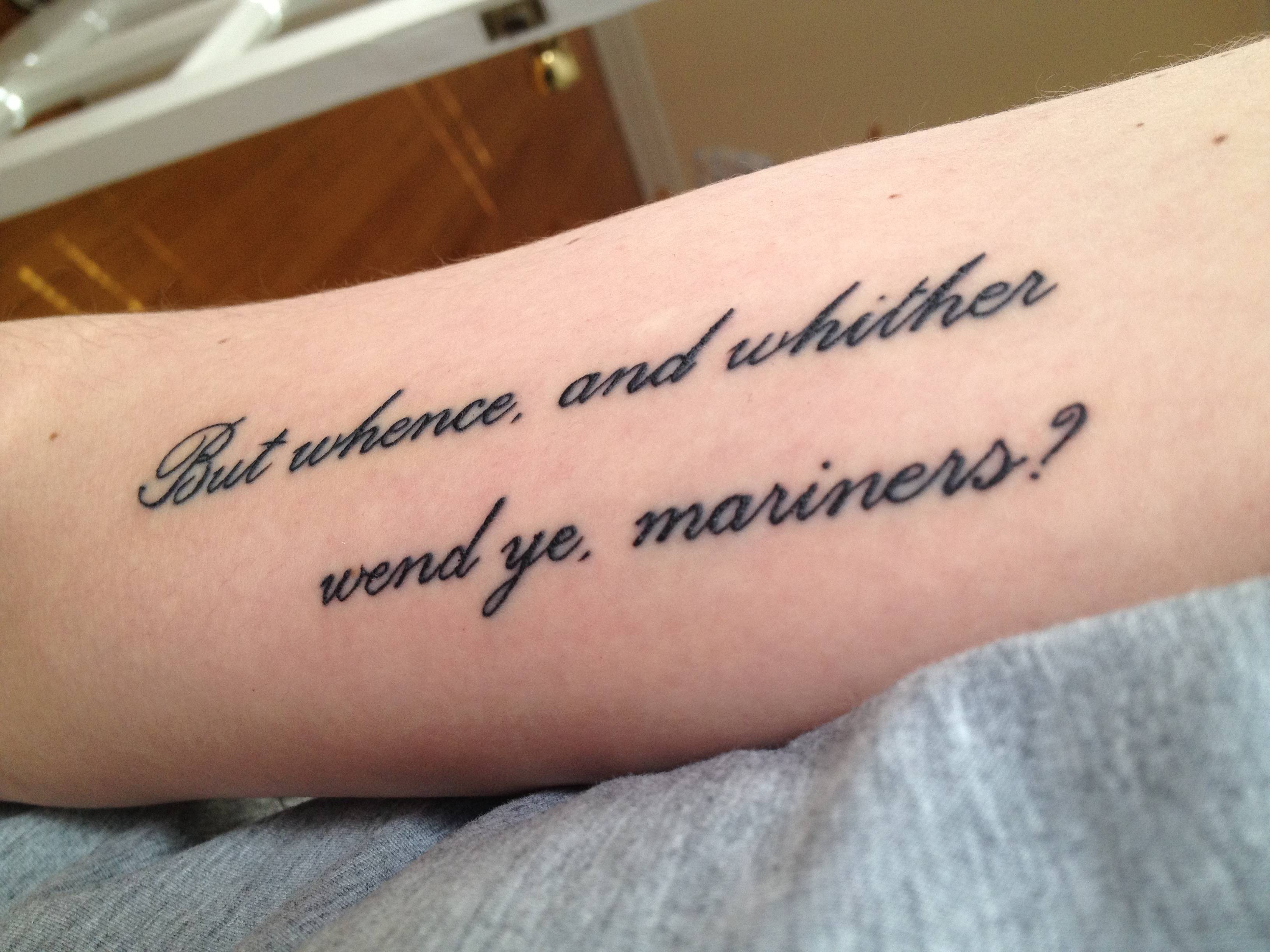
| An image search for "Mardi" yielded this tattooed quote. |
I recently came about 650 pages nearer to my goal of consuming Herman Melville in the entirety of his oeuvre by reading
Mardi, and a Voyage Thither (1849).
To Melville's third book—following
Typee: A Peep at Polynesian Life (1846) and
Omoo: A Narrative of Adventures in the South Seas (1847)—is owed the distinction of being his first true novel, which it earns through its complete desertion of factual truth.
Typee and
Omoo, despite their embellishments, still fall under the category of travel writing rather than fiction. But apparently some portion of Melville's audience regarded his story of being held the captive guest of an indigenous tribe in the Marquesas Islands, escaping in a leaking, shambolic whaling ship, and then bumming around French Polynesia after being brought ashore and imprisoned for his part in a mutiny, as far too outlandish to warrant credibility. Melville cites this skepticism in the preface to
Mardi as the impetus which led him to try his hand at a fully fictional narrative. If his provincial readers were going to accuse him of just making shit up, then why shouldn't he fabricate a narrative and see how they like it?
As it happened, "they" didn't like it very much at all. Mr. Murr of The Lectern
suggests "the Book that Cost a Career" should be substituted for "and a Voyage Thither" as
Mardi's subtitle. Melville had made a name for himself with
Typee, and followed it with the apt and well-received sequel
Omoo.
Mardi, however, received a critical mauling. Here are some excerpts of contemporaneous reviews from
The Life and Works of Herman Melville:
... [I]t is almost needless to say that we were disappointed with Mardi. It is not only inferior to Typee and Omoo, but it is a really poor production. It ought not to make any reputation for its author, or to sell sufficiently well to encourage him to attempt any thing else. --Charles Gordon Greene, in Boston Post, April 18 1849
We have seldom found our reading faculty so near exhaustion, or our good nature as critics so severely exercised, as in an attempt to get through this new work by the author of the fascinating Typee and Omoo. --George Ripley, in New York Tribune, May 10 1849
This pretension to excessive novelty has in this case resulted only in an awkward and singular melange of grotesque comedy and fantastic grandeur, which one may look for in vain in any other book. Nothing is so fatiguing as this mingling of the pompous and the vulgar, of the common-place and the unintelligible, of violent rapidity in the accumulation of catastrophes, and emphatic deliberation in the description of landscapes. These discursions, these graces, this flowery style, festooned, twisted into quaint shapes, call to mind the arabesques of certain writing masters, which render the text unintelligible. --Translation of an article by Philarète Chasles, in Paris Revue des deux mondes, May 15 1849
We proceed to notice this extraordinary production with feelings anything but gentle towards its gifted but excentric author. The truth is, that we have been deceived, inveigled, entrapped into reading a work where we had been led to expect only a book. We were flattered with the promise of an account of travel, amusing, though fictitious; and we have been compelled to pore over an undigested mass of rambling metaphysics. --Henry Cood Watson, in New York Saroni's Musical Times, September 29 1849
I can easily scorn the early critics of
Moby-Dick (1851) for being too myopic, too cavillous, and too blinded by fashionable prejudices to realize they had the American masterpiece of the century on their hands. But I can't really knock
Mardi's detractors. To put it kindly,
Mardi adds up to far less than the sum of its parts. More bluntly, Melville's first foray into fiction is a real dumpster fire.


