Thursday, February 24, 2022

flowers of the machine, part 3: gamelon of the floating world (IV)

 As I said before, this project seemed like a much better idea before it began.

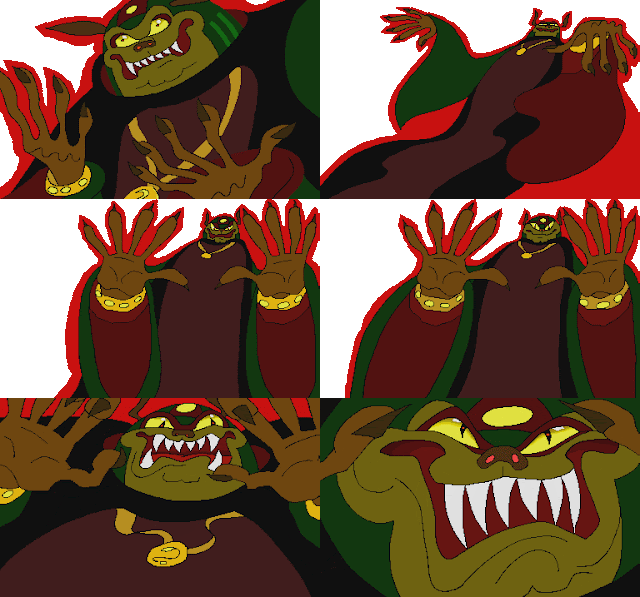
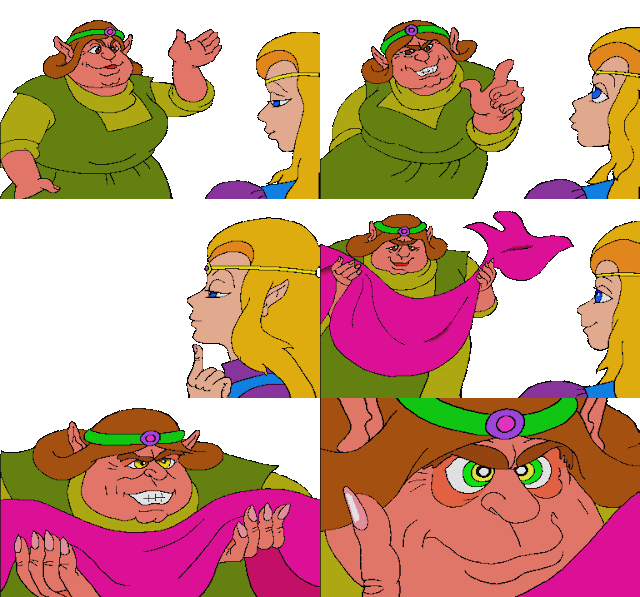
Several months after I first watched it (and re- and rewatched it), YouTube rerecommended me the Zelda CDi Reanimated Collab—again. And like a cat who can't help itself from batting at a foxtail dangling in front of its face, I clicked the link and watched it—again.

This time, for whatever reason, I imagined a scenario where an alien anthropologist, visiting Earth thousands of years in the future, somehow found itself viewing the ZCRC in the vine-shrouded shambles of an old server bank. (No, I don't know how it would accomplish this. Alien science.) What if, somehow, this very video was one of the only digital artifacts from the twenty-first century that the visitor could reconstruct in toto? Given this clue, what would the curious alien surmise of humanity's way of life in the twilight years of its global civilization?

That was the handle of it: pretending that the ZCRC wasn't just a silly piece of internet ephemera, but something that deserved a thoroughgoing accounting for, as though the description "YouTube video about the cutscenes from a so-bad-it's-funny 1990s video game" would be received with an uncomprehending stare.

Since I'm too afraid to reread the first three parts of this exercise and discover that I'm actually a babbling idiot, let's please assume that I've given an adequately explication of the ZCRC in terms of the medium in which it occurs, the persons who made it, and its cultural functions, all as outcomes of historical processes. All that remains is to guess at what it means.


MEANINGS: GAMELON OF THE FLOATING WORLD

As the seasons passed and his missions continued, Marco mastered the Tartar language and the national idioms and tribal dialects. Now his accounts were the most precise and detailed that the Great Khan could wish and there was no question or curiosity which they did not satisfy. And yet each piece of information about a place recalled to the emperor's mind that first gesture or object with which Marco had designated the place. The new fact received a meaning from that emblem and also added to the emblem a new meaning. Perhaps, Kublai thought, the empire is nothing but a zodiac of the mind's phantasms.

"On the day when I know all the emblems," he asked Marco, "shall I be able to possess my empire, at last?"

And the Venetian answered: "Sire, do not believe it. On that day you will be an emblem among emblems." 
   —Italo Calvino, Invisible Cities (1972)

 
What does the Zelda CDi Reanimated Collab mean? What do The Faces of Evil and The Wand of Gamelon mean, for that matter?

Saturday, February 12, 2022

flowers of the machine, part 3: gamelon of the floating world (III)

Games, like institutions, are extensions of social man and of the body politic, as technologies are extensions of the animal organism. Both games and technologies are counter-irritants or ways of adjusting to the stress of the specialized actions that occur in any social group. As extensions of the popular response to the workaday stress, games become faithful models of a culture. They incorporate both the action and the reaction of whole populations in a single dynamic image.
   —Marshall McLuhan, Understanding Media (1964)

Of course, "games" meant something totally different in 1964 than today. But the good professor is still worth listening to on the topic, I think.

So, once again, we're examining the technical and cultural backdrop of a silly YouTube video where a couple hundred different animators set new moving pictures to the old noises from two of the most embarrassing video games ever made.

This seemed like a such a good idea a month or two back. I was drinking more back then. Early winter and all.


MYTHS: THE MUTATIONS OF NARRATIVE

Who are the mythmakers?

First, it depends on what we mean by "myths." We'll come back to that.

Second: it depends on how a culture is organized, and the technology it uses.

Sunday, January 9, 2022

flowers of the machine, part 3: gamelon of the floating world (II)

In case you missed our last episode (and I don't see how a 6000-word blog post about the evolving phenomenology of the art-object shouldn't be at the top of everyone's reading list), we're scrutinizing the techno-sociological paradigm which the Zelda CDi Reanimated Collab instantiates. Excogitations upon the trivial can sometimes illuminate more of our world than an enquiry into a grand figure or theme, and while I can't promise that will be the outcome here, maybe we'll get lucky.

For the ReAnimated Collab version, see here.

MAKERS: THE ARTIST JOINS THE PRECARIAT

A decade ago we all assumed, or at least hoped, that the net would bring so many benefits to so many people that those unfortunates who weren't being paid for what they used to do would end up doing even better by finding new ways to get paid. You still hear that argument being made, as if people lived forever and can afford to wait an eternity to have the new source of wealth revealed to them.
   
—Jaron Lanier, You Are Not a Gadget (2010)

Who makes art?

An unusual feature of the modern epoch is the new inequivalence between this question and the more generic "who makes things?". 

Wednesday, December 29, 2021

flowers of the machine, part 3: gamelon of the floating world (I)

Every text builds on pretext.
     —Walter Ong, Orality and Literacy (1982)


About a year ago, YouTube's mysterious, incontrovertible algorithms served me a video titled "The Zelda CDi Reanimated Collab!" I don't suppose the recommendation changed my life, but good god—I watched it enough times to inadvertently memorize most of the dialogue, and I'm fairly sure this is something I ought to be ashamed of.

Probably most people who'd peer at this crusty old blog are old enough to remember the 1993 CD-i Legend of Zelda games—even though they've almost certainly never played them. During the early-to-mid 2000s, when the internet acquired its voracious appetite for the grotesque, Link: The Faces of Evil and Zelda: The Wand of Gamelon were a phenomenon on the message boards and pop culture excavation blogs. But for anyone who isn't familiar: in 1990, the Dutch electronics company Phillips released a home console that ran software and games formatted on proprietary compact discs. Due to some legal agreements made during the CD-i's development (it's complicated), Phillips found itself with a license to make games featuring copyrighted Nintendo characters. In its most well-known attempt to capitalize on this arrangement, Phillips outsourced the production of two legitimized bastard Legend of Zelda games to the Russian-American studio Animation Magic, providing scant resources and demanding an exacting turnaround time. And the rest is infamy.

To put it exceedingly gently, Faces of Evil and Wand of Gamelon weren't very good. But what stoked the internet's delirious fascination with them wasn't the third-party jankiness of their action-adventure molds, but their full-motion video cutscenes. The animations, produced by a Russian team flown over to the United States, beggar description. The words "flat," "uncanny," "maladroit," and "charmless" all come to mind, but none really approach how astonishingly ugly these FMVs are. Combined with their hammy voice acting, obtuse dialogue, and very fact of their inclusion in games that brazenly sold themselves as authentic Legend of Zelda sequels, CD-i Zelda's cutscenes transcend mere ineptitude. They are sublimely embarrassing—a thoroughgoing and wholly avoidable blunder on the order of the Borja Ecce Mono. 

Sunday, November 14, 2021

Forgotten Superheroes (vol.6): Ravage 2099 (pt 3)

(March 1995)

Please take a moment to compare the cover of Ravage 2099 #28 (above) with the cover of issue #1 (here).

This is amazing. In the world of mainstream American comic books, we see something like this about as often as a female superhero without an hourglass figure.

The writers, editors, publishers, and corporate overlords of superhero properties understand that carelessly altering a title character's image is bad business. During the mid-twentieth century, Comic books with Superman, Batman, Captain Marvel, the Flash, et al. on their covers were greedily plucked from newsstands by kids who recognized the characters, had learned what to expect from books emblazoned with their names and images, and were seldom disappointed by their purchases. Mainline superhero comics are comfort food. They're Coca-Cola. You don't change the formula unless competitors are encroaching on your market share, or buyers begin to lose their appetite for the product altogether. Every time a reformed villain reverts his old ways, every time a mourned ally is found alive and well, every time Superman is system restored to his 1986 update, kid Cable gets shunted aside for the return of old Cable, and Stephanie Brown becomes Robin/Batgirl and then becomes Spoiler again, the United States comic book industry pantomimes the New Coke/Coca-Cola Classic imbroglio-turned-success story—except in these cases, the rebranding and de-rebranding aren't motivated by panic, but have been integrated into the business model of a longstanding (but lately metastable) sector of the culture industry.

However: if a successful firm debuts a completely new product—say, Pepsi Blue—and nobody buys it, the smart businessman may be better off retiring it than sinking more resources into redeveloping and reselling something nobody wanted in the first place.

Sunday, November 7, 2021

Forgotten Superheroes (vol.6): Ravage 2099 (pt 2)

(Sept. 1993)

When we last left the fallen bureaucrat turned-ecological avenger Paul-Philip Ravage, he'd escaped from Hellrock with his humanity intact, recruited Tiana (former secretary and Strong Female Deuteragonist) and Dack (recently orphaned Pint Sized Plucky Black Kid Sidekick), and broke into Eco Central to steal a digital disc containing detailed evidence of Alchemax's wrongdoing. 

What's next for this ragtag band of outlaws, brought together by fate? Will they remain on the run, fending off Alchemax's armored goons and high-tech assassins as they wage a covert war of sabotage and propaganda against the odious megacorporation?

You'd think so. This was the spike for which Ravage 2099 co-creators Stan Lee and Paul Ryan set up the book's successors, Pat Mills and Tony Skinner—who were also writing Punisher 2099 at the time. (There's a slim chance you recognize Mills from his involvement in the long-running British science-fiction anthology comic 2000 AD, probably best known for its recurring character Judge Dredd.) All Mills and Skinner had to do was survey Ravage's trajectory over the course of eight tightly plotted issues and harness the book's momentum to everyone's mutual advantage.

Instead, they elected to start again from scratch.

Saturday, November 6, 2021

Forgotten Superheroes (vol.6): Ravage 2099 (pt 1)

Some years back, I went on an intense but incomplete Marvel 2099 binge, revisiting X-Men 2099 and reading Doom 2099, X-Nation 2099, and 2099: Manifest Destiny for the first time. It was a mixed bag, and filled with more coal than diamonds, sure, but the experience only deepened my affection for Marvel Comics' brief-lived stint at coordinated cyberpunk worldbuilding. Later on, I checked out Peter David's excellent Spider-Man 2099 and Pat Mills and Tony Skinner's satirically over-the-top Punisher 2099.¹ Like every 2099 title, their endings left a lot to be desired—but that's to be expected when an entire line of serials is suddenly and simultaneously cancelled.

I've held my nose and read 2099: World of Tomorrow in its bleak entirety. I've skimmed the pages of Ghost Rider 2099, and briefly glanced at the adventures of John Eisenhart in 2099 Unlimited and Hulk 2099. But until recently, I hadn't the nerve to explore what I understood to be one of the Marvel 2099 world's most fraught territories.

(December 1992)

So I finally checked out Ravage 2099.² I think I'm glad I did, because it's got to be one of the damned strangest capeshit comics to come out of the 1990s. I am writing this overview of the series for two reasons. First: in case somebody ever punches "ravage 2099" into a search engine and isn't satisfied with the glancing treatment in Wikipedia/Fandom articles and potboiler summaries by CBR freelancers, they'll find a somewhat better resource if they scroll the results long enough.

Second: I'm seriously weirded out by this comic book, and maybe writing about it will help me get over it.