Monday, April 4, 2022

Magic: The Gathering: The Worldbuilding: The Writeup (2 of 8)


If I had to rank my favorite Magic: The Gathering artists, Amy Weber and her buoyant, diagrammatic compositions would be somewhere in the top three. What exactly are we seeing in Curse of Marit Lage? How does it relate to the card's in-game effect? Who knows! But it sure is fun to look at.

I really miss old Magic art. In the mid-1990s, Wizards of the Coasts' artist coterie was full of people whose work was impossible to mistake fom anyone else's. Amy Weber, of course. Richard Kane Ferguson. Kaja and Phil Foglio. Drew Tucker. Rebecca Guay. Andi Rusu. Even that deranged nazi fuck Harold McNeill. In its early years, Magic's signature "look" was a composite of diverse art styles, imbuing the fantasy world depicted in the cards and the aesthetic experiences of the game they're used in with a touch of surreality, of the protean, of...well, magic.

Scrolling through these writeups and just looking at the card images is sort like watching a time-lapse video of a flower blooming or a carcass decomposing. By the time we get to the end of the decade, the art doesn't look very much at all like it did at the beginning. After another eight years, the difference between Mark Poole's Counterspell and Jason Chan's Counterspell is as stark as the contrast between how Jack Kirby and Jim Lee drew the X-Men. Nowadays, Magic art is sleek, consistent, and exquisitely polished—but not as much fun as it was when it was still a hodgepodge, and before Wizards ran its art department like a factory. 

...Anyway. Let's get on with it.

___________

Monday, March 28, 2022

Magic: The Gathering: The Worldbuilding: The Writeup (1 of 8)


Postscript: This was written in fits and starts, spaced out across about five months—usually coinciding with Wizards of the Coast previewing a new Magic: The Gathering expansion and releasing the associated web fiction. As usual, one of the motivators of this "exercise" is the idea that I can apply to myself the parental logic of forcing a child to smoke an entire pack of cigarettes after catching him lighting up in the garage.*  It's worked before, and the results were usually something I could live with. This time...I'm not so sure.

For the Magic: The Gathering fan/addict (what's the difference?) who happens upon this writeup, I suspect it'll be so much catnip. For the person who's never thought about or spent any money on the damn cards, it could be an entertaining dive into an entertainment product that rakes in upwards of $580 million a year, forms the basis of an esoteric subset of geek/gamer culture that's probably larger than most people think, and achieved with nothing but colorful pieces of carboard the same degree of slavish patronage which World of Warcraft needed the Unreal Engine and cable internet to inspire in its players.

For people in my age group (read: old) who played for a couple of years in middle school and then wandered off, never to return, it might be a fun way to see how much the game changed over the years.

I should say in advance that I'm not going to be looking at every single Magic set. There's a point where R&D refines its approach to worldbuilding into almost a matter of rote method, and where most of what can be said about a given set is "so-and-so happens in the story," "it's a lot like such-and-such previous set," and "it's inspired by this-and-that real-world culture and folklore." We won't be venturing very far into the post-Mending era.

Since most of these have already been written and need only some touch-ups and pictures, I think I can stand to post them weekly—which might mean I have two months' worth of updates on deck. If I weren't so ashamed of myself for having written so much about Magic: The Gathering, I'd be very pleased.
___________

Wednesday, March 2, 2022

The conspiracy of NFTs


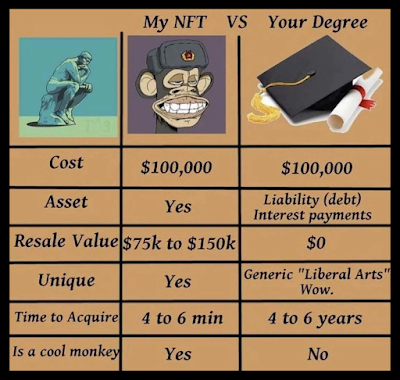
Everybody hates NFTs and is sick of hearing about them, barring the people who have gotten, or are hoping to get rich (or richer) from making and selling NFT art—and we might getting of sick of them, too. We're tired of the phantom whiffs of vape oil and cannabis we get whenever we glimpse a fugitive Bored Ape Yacht Club avatar, and we're tried of gnashing our teeth when we hear that some insipid, procedurally generated .png with a blockchain receipt sold for tens of thousands of dollars. We're even getting weary of reading articles about our collective hatred of NFTs. And yet, the media persists in telling us that the damn things are here to stay, and that we'll all soon embrace them as willingly as we did credit cards, Farmville, Instagram, or any other parasitic technology. Surely the incessant anti-NFT chatter helps to fulfill the prophecy, crystallizing the inevitability of Web3 the same way Freddy Krueger grows strong by feeding on the fears of his future victims.

Nevertheless, we are now, reluctantly looking into the mirror and chanting "non-fungible asset tokens" three times. What compelled me to this was Wikipedia's decision to classify Cryptopunks and their ilk as NFTs—not as "art."

Though it pains me to say it, I don't think this was the right call. "Art" is a word whose meaning lost all coherence around the same time the cabal of critics and curators retroactively canonized Marcel Duchamp's Fountain. If what we talk about when we talk about art is the stuff we see in museums or read about in Artforum, it's hard to deny that NFTs fit the profile. If Banksy's stencil graffiti or Warhol's screen prints of camouflage patterns get to be Art, then who are Wikipedia's editors to say that a .jpg with a blockchain ledger "pointing" to it belongs to a separate, lesser category of cultural artifact?

Not only would I argue that NFTs deserve to be categorized as art, but that they represent the next logical step in the evolution of contemporary art, and of the art market (and truly, it is impossible to separate the two). But what's more important is how they arrived at this position: by a feat of reductio ad absurdum.

Thursday, February 24, 2022

flowers of the machine, part 3: gamelon of the floating world (IV)

 As I said before, this project seemed like a much better idea before it began.

Several months after I first watched it (and re- and rewatched it), YouTube rerecommended me the Zelda CDi Reanimated Collab—again. And like a cat who can't help itself from batting at a foxtail dangling in front of its face, I clicked the link and watched it—again.

This time, for whatever reason, I imagined a scenario where an alien anthropologist, visiting Earth thousands of years in the future, somehow found itself viewing the ZCRC in the vine-shrouded shambles of an old server bank. (No, I don't know how it would accomplish this. Alien science.) What if, somehow, this very video was one of the only digital artifacts from the twenty-first century that the visitor could reconstruct in toto? Given this clue, what would the curious alien surmise of humanity's way of life in the twilight years of its global civilization?

That was the handle of it: pretending that the ZCRC wasn't just a silly piece of internet ephemera, but something that deserved a thoroughgoing accounting for, as though the description "YouTube video about the cutscenes from a so-bad-it's-funny 1990s video game" would be received with an uncomprehending stare.

Since I'm too afraid to reread the first three parts of this exercise and discover that I'm actually a babbling idiot, let's please assume that I've given an adequately explication of the ZCRC in terms of the medium in which it occurs, the persons who made it, and its cultural functions, all as outcomes of historical processes. All that remains is to guess at what it means.


MEANINGS: GAMELON OF THE FLOATING WORLD

As the seasons passed and his missions continued, Marco mastered the Tartar language and the national idioms and tribal dialects. Now his accounts were the most precise and detailed that the Great Khan could wish and there was no question or curiosity which they did not satisfy. And yet each piece of information about a place recalled to the emperor's mind that first gesture or object with which Marco had designated the place. The new fact received a meaning from that emblem and also added to the emblem a new meaning. Perhaps, Kublai thought, the empire is nothing but a zodiac of the mind's phantasms.

"On the day when I know all the emblems," he asked Marco, "shall I be able to possess my empire, at last?"

And the Venetian answered: "Sire, do not believe it. On that day you will be an emblem among emblems." 
   —Italo Calvino, Invisible Cities (1972)

 
What does the Zelda CDi Reanimated Collab mean? What do The Faces of Evil and The Wand of Gamelon mean, for that matter?

Saturday, February 12, 2022

flowers of the machine, part 3: gamelon of the floating world (III)

Games, like institutions, are extensions of social man and of the body politic, as technologies are extensions of the animal organism. Both games and technologies are counter-irritants or ways of adjusting to the stress of the specialized actions that occur in any social group. As extensions of the popular response to the workaday stress, games become faithful models of a culture. They incorporate both the action and the reaction of whole populations in a single dynamic image.
   —Marshall McLuhan, Understanding Media (1964)

Of course, "games" meant something totally different in 1964 than today. But the good professor is still worth listening to on the topic, I think.

So, once again, we're examining the technical and cultural backdrop of a silly YouTube video where a couple hundred different animators set new moving pictures to the old noises from two of the most embarrassing video games ever made.

This seemed like a such a good idea a month or two back. I was drinking more back then. Early winter and all.


MYTHS: THE MUTATIONS OF NARRATIVE

Who are the mythmakers?

First, it depends on what we mean by "myths." We'll come back to that.

Second: it depends on how a culture is organized, and the technology it uses.

Sunday, January 9, 2022

flowers of the machine, part 3: gamelon of the floating world (II)

In case you missed our last episode (and I don't see how a 6000-word blog post about the evolving phenomenology of the art-object shouldn't be at the top of everyone's reading list), we're scrutinizing the techno-sociological paradigm which the Zelda CDi Reanimated Collab instantiates. Excogitations upon the trivial can sometimes illuminate more of our world than an enquiry into a grand figure or theme, and while I can't promise that will be the outcome here, maybe we'll get lucky.

For the ReAnimated Collab version, see here.

MAKERS: THE ARTIST JOINS THE PRECARIAT

A decade ago we all assumed, or at least hoped, that the net would bring so many benefits to so many people that those unfortunates who weren't being paid for what they used to do would end up doing even better by finding new ways to get paid. You still hear that argument being made, as if people lived forever and can afford to wait an eternity to have the new source of wealth revealed to them.
   
—Jaron Lanier, You Are Not a Gadget (2010)

Who makes art?

An unusual feature of the modern epoch is the new inequivalence between this question and the more generic "who makes things?". 

Wednesday, December 29, 2021

flowers of the machine, part 3: gamelon of the floating world (I)

Every text builds on pretext.
     —Walter Ong, Orality and Literacy (1982)


About a year ago, YouTube's mysterious, incontrovertible algorithms served me a video titled "The Zelda CDi Reanimated Collab!" I don't suppose the recommendation changed my life, but good god—I watched it enough times to inadvertently memorize most of the dialogue, and I'm fairly sure this is something I ought to be ashamed of.

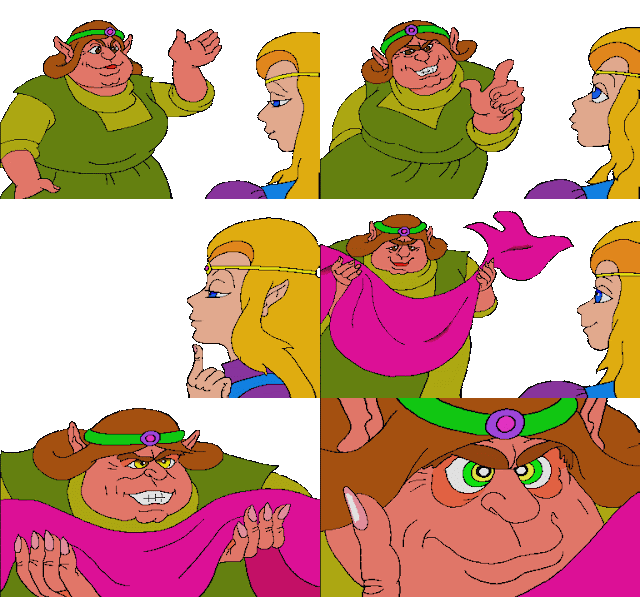
Probably most people who'd peer at this crusty old blog are old enough to remember the 1993 CD-i Legend of Zelda games—even though they've almost certainly never played them. During the early-to-mid 2000s, when the internet acquired its voracious appetite for the grotesque, Link: The Faces of Evil and Zelda: The Wand of Gamelon were a phenomenon on the message boards and pop culture excavation blogs. But for anyone who isn't familiar: in 1990, the Dutch electronics company Phillips released a home console that ran software and games formatted on proprietary compact discs. Due to some legal agreements made during the CD-i's development (it's complicated), Phillips found itself with a license to make games featuring copyrighted Nintendo characters. In its most well-known attempt to capitalize on this arrangement, Phillips outsourced the production of two legitimized bastard Legend of Zelda games to the Russian-American studio Animation Magic, providing scant resources and demanding an exacting turnaround time. And the rest is infamy.

To put it exceedingly gently, Faces of Evil and Wand of Gamelon weren't very good. But what stoked the internet's delirious fascination with them wasn't the third-party jankiness of their action-adventure molds, but their full-motion video cutscenes. The animations, produced by a Russian team flown over to the United States, beggar description. The words "flat," "uncanny," "maladroit," and "charmless" all come to mind, but none really approach how astonishingly ugly these FMVs are. Combined with their hammy voice acting, obtuse dialogue, and very fact of their inclusion in games that brazenly sold themselves as authentic Legend of Zelda sequels, CD-i Zelda's cutscenes transcend mere ineptitude. They are sublimely embarrassing—a thoroughgoing and wholly avoidable blunder on the order of the Borja Ecce Mono.