This is going to be a long one, but I want to get the Weatherlight Saga out of the way. It's sort of like 1990s superhero comics: full of iconic characters and landmark events, but much more impressive in retrospect than in its execution.
Monday, April 18, 2022
Monday, April 11, 2022
Magic: The Gathering: The Worldbuilding: The Writeup (3 of 8)
I just finished Elden Ring and you made me realize it's basically the same thing as Magic, except item descriptions are the equivalent of cards. It's just a bunch of free-floating "lore" without any plot or meeting any of the mentioned characters, give or take a few boss fights. Is raw lore that interesting? I suppose it's a nerd thing?
That's...that's exactly right. I've never played Elden Ring or any of Hidetaka Miyazaki's other games (and yes, I know, I'm all the poorer for it), I did play Blasphemous earlier this year, which I understand is a Souls/Metroidvania hybrid.
Blasphemous' story, as communicated during the occasional moments of dialogue, explains what's happening as though the player were already acculturated to Cvstodia and didn't need to be brought up to speed on the Miracle, the Church, or the Brotherhood of the Silent Sorrow, and the effect is that you're operating in the dark for most of the game. The descriptions of the items you collect supply fragmentary information about the land's history, its people, the origins of its monsters, its morbid religion, and the depravity of its leaders. Some of it is important; a lot of it is trivial. But it helps a game that would otherwise be an above-average Metroidvania romp with a unique and brilliantly realized aesthetic tunnels deep into your brain. You're presented with a scenario and you want to make sense of it, to create meaning from the patterns with which you're presented, and you can only make progress by being proactive. Blasphemous doesn't tell you its story; it leaves pieces of it lying around for the player to put together so they can make their own conjectures and draw their own conclusions.
This is precisely how Magic: The Gathering did things in its fledgling years. You collected and played with the cards, and for the most part, when you opened a booster pack of sifted through your collection, you were more interested in how a card functioned than what it revealed about any imaginary world. But you were still looking at the art and reading the flavor text; the ambiance of the setting and the story (even when the story was rudimentary) was inescapable. The same compulsion to make sense of a pattern was apt to assert itself—and, yes, I suppose nerds are particularly susceptible to this sort of thing.
Monday, April 4, 2022
Magic: The Gathering: The Worldbuilding: The Writeup (2 of 8)
If I had to rank my favorite Magic: The Gathering artists, Amy Weber and her buoyant, diagrammatic compositions would be somewhere in the top three. What exactly are we seeing in Curse of Marit Lage? How does it relate to the card's in-game effect? Who knows! But it sure is fun to look at.
I really miss old Magic art. In the mid-1990s, Wizards of the Coasts' artist coterie was full of people whose work was impossible to mistake fom anyone else's. Amy Weber, of course. Richard Kane Ferguson. Kaja and Phil Foglio. Drew Tucker. Rebecca Guay. Andi Rusu. Even that deranged nazi fuck Harold McNeill. In its early years, Magic's signature "look" was a composite of diverse art styles, imbuing the fantasy world depicted in the cards and the aesthetic experiences of the game they're used in with a touch of surreality, of the protean, of...well, magic.
Scrolling through these writeups and just looking at the card images is sort like watching a time-lapse video of a flower blooming or a carcass decomposing. By the time we get to the end of the decade, the art doesn't look very much at all like it did at the beginning. After another eight years, the difference between Mark Poole's Counterspell and Jason Chan's Counterspell is as stark as the contrast between how Jack Kirby and Jim Lee drew the X-Men. Nowadays, Magic art is sleek, consistent, and exquisitely polished—but not as much fun as it was when it was still a hodgepodge, and before Wizards ran its art department like a factory.
...Anyway. Let's get on with it.
Monday, March 28, 2022
Magic: The Gathering: The Worldbuilding: The Writeup (1 of 8)
Wednesday, March 2, 2022
The conspiracy of NFTs
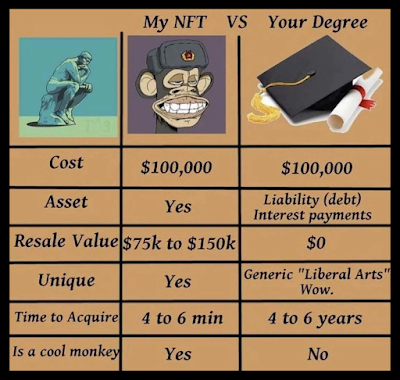
Everybody hates NFTs and is sick of hearing about them, barring the people who have gotten, or are hoping to get rich (or richer) from making and selling NFT art—and we might getting of sick of them, too. We're tired of the phantom whiffs of vape oil and cannabis we get whenever we glimpse a fugitive Bored Ape Yacht Club avatar, and we're tried of gnashing our teeth when we hear that some insipid, procedurally generated .png with a blockchain receipt sold for tens of thousands of dollars. We're even getting weary of reading articles about our collective hatred of NFTs. And yet, the media persists in telling us that the damn things are here to stay, and that we'll all soon embrace them as willingly as we did credit cards, Farmville, Instagram, or any other parasitic technology. Surely the incessant anti-NFT chatter helps to fulfill the prophecy, crystallizing the inevitability of Web3 the same way Freddy Krueger grows strong by feeding on the fears of his future victims.
Nevertheless, we are now, reluctantly looking into the mirror and chanting "non-fungible asset tokens" three times. What compelled me to this was Wikipedia's decision to classify Cryptopunks and their ilk as NFTs—not as "art."
Thursday, February 24, 2022
flowers of the machine, part 3: gamelon of the floating world (IV)
As I said before, this project seemed like a much better idea before it began.
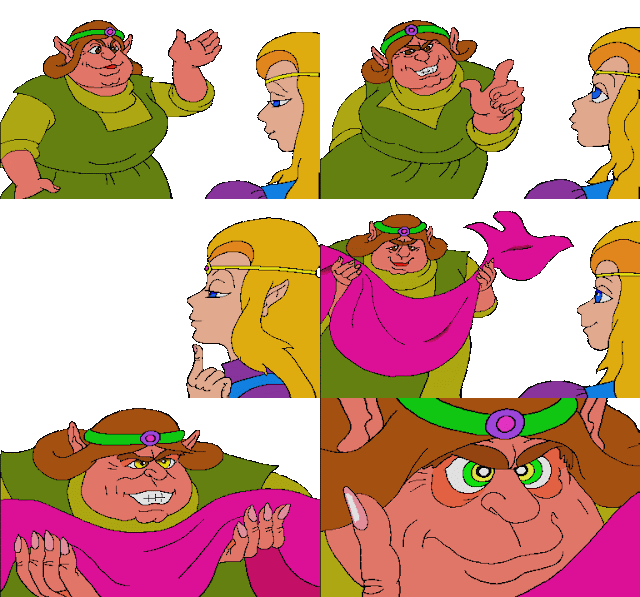
Several months after I first watched it (and re- and rewatched it), YouTube rerecommended me the Zelda CDi Reanimated Collab—again. And like a cat who can't help itself from batting at a foxtail dangling in front of its face, I clicked the link and watched it—again.
This time, for whatever reason, I imagined a scenario where an alien anthropologist, visiting Earth thousands of years in the future, somehow found itself viewing the ZCRC in the vine-shrouded shambles of an old server bank. (No, I don't know how it would accomplish this. Alien science.) What if, somehow, this very video was one of the only digital artifacts from the twenty-first century that the visitor could reconstruct in toto? Given this clue, what would the curious alien surmise of humanity's way of life in the twilight years of its global civilization?
That was the handle of it: pretending that the ZCRC wasn't just a silly piece of internet ephemera, but something that deserved a thoroughgoing accounting for, as though the description "YouTube video about the cutscenes from a so-bad-it's-funny 1990s video game" would be received with an uncomprehending stare.
Since I'm too afraid to reread the first three parts of this exercise and discover that I'm actually a babbling idiot, let's please assume that I've given an adequately explication of the ZCRC in terms of the medium in which it occurs, the persons who made it, and its cultural functions, all as outcomes of historical processes. All that remains is to guess at what it means.
As the seasons passed and his missions continued, Marco mastered the Tartar language and the national idioms and tribal dialects. Now his accounts were the most precise and detailed that the Great Khan could wish and there was no question or curiosity which they did not satisfy. And yet each piece of information about a place recalled to the emperor's mind that first gesture or object with which Marco had designated the place. The new fact received a meaning from that emblem and also added to the emblem a new meaning. Perhaps, Kublai thought, the empire is nothing but a zodiac of the mind's phantasms.
"On the day when I know all the emblems," he asked Marco, "shall I be able to possess my empire, at last?"
And the Venetian answered: "Sire, do not believe it. On that day you will be an emblem among emblems."
—Italo Calvino, Invisible Cities (1972)
What does the Zelda CDi Reanimated Collab mean? What do The Faces of Evil and The Wand of Gamelon mean, for that matter?
Saturday, February 12, 2022
flowers of the machine, part 3: gamelon of the floating world (III)
Games, like institutions, are extensions of social man and of the body politic, as technologies are extensions of the animal organism. Both games and technologies are counter-irritants or ways of adjusting to the stress of the specialized actions that occur in any social group. As extensions of the popular response to the workaday stress, games become faithful models of a culture. They incorporate both the action and the reaction of whole populations in a single dynamic image.—Marshall McLuhan, Understanding Media (1964)